Insights
The Servant King: Power, Purpose & Universal Justice in the Story of Dhū'l-Qarnayn
Listen to this page
Reads aloud using your device voice
Introduction: Power, Clout, and True Leadership
In today's world, leadership is often associated with popularity, flex culture, social media clout, and personal wealth. We see influencers, CEOs, and political leaders boasting about their empires and achievements. Young people are constantly fed the message that success means climbing to the top and using power for self-aggrandizement. This leads many youth to ask: What does real power look like? How should a Muslim handle success, influence, talent, or authority when given the chance to lead?
The Qur'an addresses these modern questions through the inspiring historical figure of Dhū'l-Qarnayn in Surah Al-Kahf (18:83–98).
Dhū'l-Qarnayn was a powerful ruler given unprecedented global authority, military strength, and technological resources by Allah (God). Yet, instead of becoming a tyrant or exploiting weaker nations, he traveled the world establishing absolute justice, defending the oppressed, refusing bribes, and attributing every single achievement to the mercy of Allah (God). His story provides young Muslims with an unshakeable blueprint for ethical leadership, intellectual humility, and servant hood in the modern world.
1. The Divine Anchor: Quranic References
وَيَسْأَلُونَكَ عَن ذِي الْقَرْنَيْنِ ۖ قُلْ سَأَتْلُو عَلَيْكُم مِّنْهُ ذِكْرًا إِنَّا مَكَّنَّا لَهُ فِي الْأَرْضِ وَآتَيْنَاهُ مِن كُلِّ شَيْءٍ سَبَبًا
“And they ask you, [O Muhammad], about Dhū'l-Qarnayn. Say: 'I shall recite to you something of his story.' Indeed, We established him on earth and gave him the means (Sabab) to everything.”
— Surah Al-Kahf (18:83–84)
قَالَ مَا مَكَّنِّي فِيهِ رَبِّي خَيْرٌ فَأَعِينُونِي بِقُوَّةٍ أَجْعَلْ بَيْنَكُمْ وَبَيْنَهُمْ رَدْمًا آتُونِي زُبَرَ الْحَدِيدِ ۖ حَتَّىٰ إِذَا سَاوَىٰ بَيْنَ الصَّدَفَيْنِ قَالَ انفُخُوا ۖ حَتَّىٰ إِذَا جَعَلَهُ نَارًا قَالَ آتُونِي أُفْرِغْ عَلَيْهِ قِطْرًا
“He said: 'That in which my Lord has established me is better [than your tribute/bribe]. So help me with strength [manpower]; I will erect between you and them a barrier. Bring me blocks of iron!' Then, when he had filled up the gap between the two mountain-cliffs, he said: 'Blow!' Then when he made it [glow as] fire, he said: 'Bring me molten copper to pour over it.'”
— Surah Al-Kahf (18:95–96)
قَالَ هَٰذَا رَحْمَةٌ مِّن رَّبِّي ۖ فَإِذَا جَاءَ وَعْدُ رَبِّي جَعَلَهُ دَكَّاءَ ۖ وَكَانَ وَعْدُ رَبِّي حَقًّا
“[Dhū'l-Qarnayn] said: 'This [barrier] is a mercy from my Lord. But when the promise of my Lord comes, He will level it to the ground. And the promise of my Lord is ever true.'”
— Surah Al-Kahf (18:98)
2. Quranic & Seerah Context
3. Brief Explanation, Lessons & Hidden Connections
Ethics Over Bribes (Rejecting Extortion)
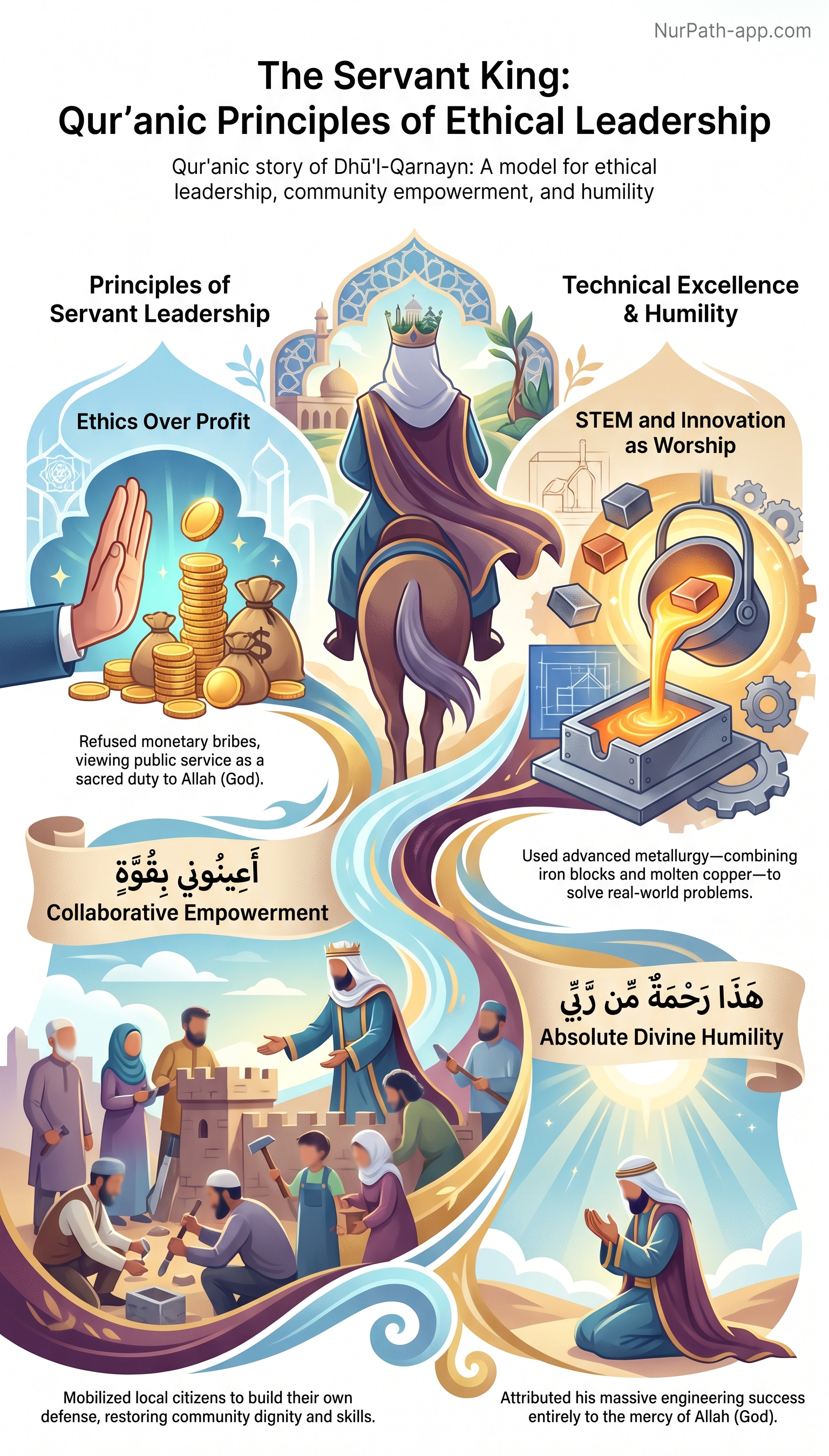
When the vulnerable people offered to pay Dhū'l-Qarnayn a monetary tribute or tax (Kharaj) to build a wall for them, he refused their money. He declared: "That in which my Lord has established me is better than your payment" (Surah Al-Kahf, 18:95). He demonstrated that true public service and Islamic leadership are motivated by duty and seeking the pleasure of Allah (God), not extracting profit from needy people.
Collaborative Empowerment ("A'īnūnī bi-quwwah")
Instead of acting like a arrogant savior who does everything while making the local population passive, Dhū'l-Qarnayn empowered them. He asked for their physical labor and manpower: "Help me with strength!" (Surah Al-Kahf, 18:95). By involving them in constructing their own defense, he restored their dignity, taught them engineering skills, and built community resilience.
Advanced Engineering & Metallurgy
Dhū'l-Qarnayn used advanced materials engineering centuries ahead of his time. He stacked large blocks of raw iron (Zubar al-ḥadīd) between the mountain cliffs, used giant bellows to heat the iron until it glowed like fire, and then poured molten copper (Qiṭr) over it (Surah Al-Kahf, 18:96). The combination formed an impenetrable iron-copper alloy rampart (Radm) that Ya'jūj and Ma'jūj could neither scale nor dig through (Surah Al-Kahf, 18:97).
Absolute Humility in Victory
Most world leaders who complete massive engineering projects erect statues or monuments to praise themselves. But after finishing this historic wall, Dhū'l-Qarnayn stood back and humbly said: "This is a mercy from my Lord" (Surah Al-Kahf, 18:98). He recognized that his intelligence, power, and materials were all gifts from Allah (God), and reminded everyone that even this massive wall will eventually turn to dust when Allah (God)'s final promise arrives.
4. Deep Reflections: Logic, Wisdom & Modern Relevance
Curing the Modern Clout & Ego Epidemic
Our modern digital culture rewards self-promotion. Dhū'l-Qarnayn possessed total global authority, yet his heart remained completely detached from pride. He proves that real honor comes from serving Allah (God) and helping humanity, not from flexing wealth or seeking online validation.
Technology and STEM as Worship
Dhū'l-Qarnayn's story shows that engineering, physics, construction, and problem-solving are high forms of service in Islam. When young Muslims study STEM fields (science, technology, engineering, and math) with the intention of solving real-world human problems—like poverty, clean water access, or cyber security—their technical work becomes a rewarding act of worship ('Ibādah).
The Ephemeral Nature of Human Achievement
Dhū'l-Qarnayn built one of the strongest barriers in human history, yet he openly stated that it is temporary (Surah Al-Kahf, 18:98). This reminds young Muslims that no matter how impressive our modern skyscrapers, software apps, or wealth may seem, everything in this temporary world (Dunya) will pass away. Only our faith and good deeds endure for the Hereafter (Akhirah).
5. Application: How to Encompass (Iḥṣā')
Adopt Servant Leadership in Your Daily Life
Whether you are a student club president, team captain, or older sibling, use your influence to uplift, defend, and support others rather than bossing them around.
Empower Others Instead of Doing it Solo
When working on school projects or volunteer initiatives, involve your peers, listen to their ideas, and help them build skills, following Dhū'l-Qarnayn's principle of "Help me with strength!"
Attribute Every Success to Allah (God)
Whenever you achieve a top grade, win a sports match, or receive praise for a project, immediately say "Alḥamdulillāh, hādhā min faḍli Rabbī" (Praise be to Allah (God), this is from the bounty of my Lord), keeping your ego grounded in humility.
Understand, Reflect & Act
Understand (The Concept)
Power as a Sacred Trust (Amanah)
Dhū'l-Qarnayn viewed his vast power and resources as a test from Allah (God) to establish justice, not to dominate people (Surah Al-Kahf, 18:84, 88).
Reflect (The Mindset)
Ethical Leadership Over Clout
Reflect on how you use your talents, popular status, or knowledge. Are you using them to serve others or to boost your own ego?
Act (The Daily Practice)
Serve Without Seeking Profit
Offer your time, tutoring, or technical skills to help a classmate or community cause this week without asking for money or praise (Surah Al-Kahf, 18:95).
Understand (The Concept)
Collaborative Empowerment
He refused to work alone; he mobilized the local people ("A'īnūnī bi-quwwah") to build their own defense (Surah Al-Kahf, 18:95).
Reflect (The Mindset)
Teamwork Over Solo Ego
Contemplate how true leaders build up the confidence and capabilities of those around them instead of doing everything solo.
Act (The Daily Practice)
Empower a Peer Today
Involve a quiet or struggling classmate in your team project, encourage their input, and share credit for the final result (Surah Al-Kahf, 18:95).
Understand (The Concept)
Ultimate Divine Humility
After building an incredible iron wall, he gave all credit to Allah (God) ("Hādhā raḥmatun min Rabbī") (Surah Al-Kahf, 18:98).
Reflect (The Mindset)
Grounding Success in Grace
Realize that every talent, high score, or skill you possess is a gift from Allah (God) that can disappear at any moment.
Act (The Daily Practice)
The Humility Reset
Whenever you receive a compliment, award, or high grade today, say "Alḥamdulillāh, this is by Allah (God)'s mercy" in your heart (Surah Al-Kahf, 18:98).
Summary
The story of Dhū'l-Qarnayn is the ultimate Qur'anic blueprint for righteous leadership, technical brilliance, and deep humility (Surah Al-Kahf, 18:84). He proved that true strength lies in standing up for justice, protecting the weak, empowering local communities, and rejecting corruption (Surah Al-Kahf, 18:95). By combining real-world skills with unshakeable faith and attributing all success to Allah (God), young Muslims can lead with confidence, dignity, and purpose in the modern world (Surah Al-Kahf, 18:98).
 nurpath-app.com
Related Insights
Sacred Titles
The Prophet's names and honorific titles as superpowers of character — a practical blueprint for identity, trust, and growth.
Anchors in the Cave
The Story of Aṣḥāb al-Kahf — a timeless blueprint for youth resilience against societal pressure.
Navigator's Code
Islamic mentorship (Tarbiyah & Suhbah) as the Prophetic blueprint that turns raw youthful potential into real-world strength.